Beginning preparations for Image One - Life Casting And Master Moulding
- thelazybookmen
- Nov 11, 2021
- 3 min read

Updated: Jan 13, 2022
For Image One, it had been decided that facial prosthetics would be included in the design, as well as a lifelike silicone face mask. For this to be achieved, a face cast of the model must be created. CastingAbout (n.d.) states that life casting is a way to capture the human form that is able to pick up fine details such as wrinkles, pores and fingerprints. The cast will allow the make-up designer to sculpt directly onto a copy of the model's face, which will ensure that the prosthetic pieces will be a perfect fit.
When casting a face, it is common practice to apply a bald cap to the model. This serves as a way to cover the hair and keep it out of the way, and also allows for a deeper cast. As this design does not require any pieces above the forehead, a wig cap was applied instead with clingfilm over the top. This alternative method saves a lot of time and is much easier, however the clingfilm can leave a lot of texture on the final cast which will need to rasped away in the later stages. A more in-depth explanation of this process can be read here.

The casting process went well however two layers of alginate needed to be applied as the first batch was too thin and slid off the face. This resulted in the alginate not creating a thick enough layer in some areas. The second batch aided in thickening those areas as to prevent any damages to the casting alginate.
Figure 2 - Life casting time-lapse. (Brown, J. 2021).
Once set, plaster bandage was applied over the top which provided a supportive shell that would allow the alginate to keep its shape.


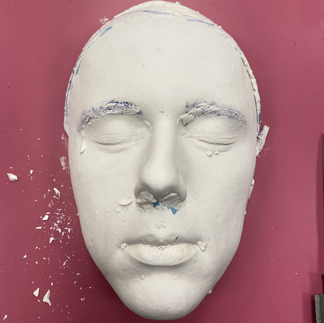


Figure 3 - Completed Life Figure 4 - Life cast before Figure 5 - Life cast after
cast (Brown, J. 2021). rasping (Brown, J. 2021). rasping (Brown, J. 2021).
The model also had his ears cast, as prosthetic ears will be created. This is done using alginate as well, with a small ball of cotton blocking the ear canal.
Polyurethane resin was used to create the positive ear. This is because when plaster has been used before, the ear had snapped off, and using polyurethane will prevent this from happening again as it is stronger than plaster.


Figure 6 - Casting ear Figure 7 - Casting ear Figure 8 - Polyurethane
(Brown, J. 2021). (Brown, J. 2021). positive ear (Brown, J. 2021).
Figure 9 - Polyurethane time-lapse (Brown, J. 2021).
As can be seen in figure 9, the polyurethane resin dripped down the sides of the alginate in the cup. This happened because the cup was slightly bigger than the alginate, however this caused the alginate to almost become entirely encased within the resin. Luckily the ears were salvaged before the resin had set, as seen in figure 8, a base will just need to be added to the bottom. If these ears were created for a snap mould to create silicone pieces, they would need to be much neater/smoother, and the right ear would most likely need to be cast again. However, the prosthetic ears will be made from latex, meaning only the sculpt itself will be moulded so the current ears do not create much of an issue.
A master mould was made from the life cast as cores will be required at later stages for the facial prosthetics. This can be read about in more detail here and here.


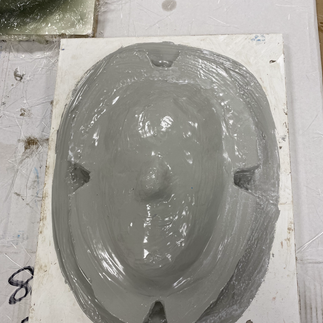


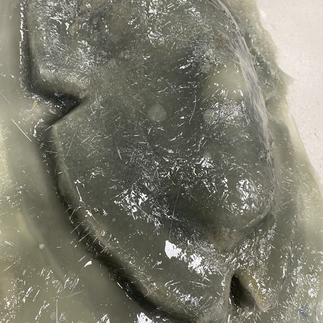


Figure 10, 11, 12, 13, 14, 15, 16, 17, 18, 19, 20, 21 - Master moulding process (Brown, J. 2021).
Compared to previous attempts at creating a master mould and using fibreglass, this mould and jacket has come out significantly better. There are improvements that still could be made, as air bubbles got trapped in the polyester resin. To improve, the keys will be made much taller to ensure the silicone doesn't cover them, as trying to cut through it later makes the silicone really uneven, and more time will be spent trying to keep out any air bubbles when fibreglassing. The more this process is carried out, the better the end result will become.
Example of a previous attempt for comparison:


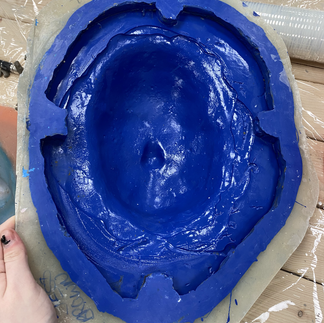


Figure 22 - Master mould Figure 23 - Master mould Figure 24 - Master mould
(Brown, J. 2020). (Brown, J. 2020). (Brown, J. 2020).
-Jess
References:
CastingAbout (n.d.) Alginate, Mod-roc and plaster [Online] Available at: http://www.castingabout.co.uk/Life-Casting.html (Accessed 06 October 2021).
Bibliography:
Debreceni, T. (2013) Special Makeup Effects for Stage and Screen: Making and Applying Prosthetics. Oxfordshire, Taylor & Francis.
Figures:
Figure 1, 2, 3 - Brown, J. (2021) Bradford.
Figure 4 , 5 - Brown, J. (2021) York College.
Figure 6, 7 - Brown, J. (2021) Bradford.
Figure 8 - Brown, J. (2021) Leeds.
Figure 9, 10, 11, 12, 13, 14, 15, 16, 17, 18, 19, 20, 21, 22, 23, 24 - Brown, J. (2021) York College.


Comments